
Log without Leitmotif
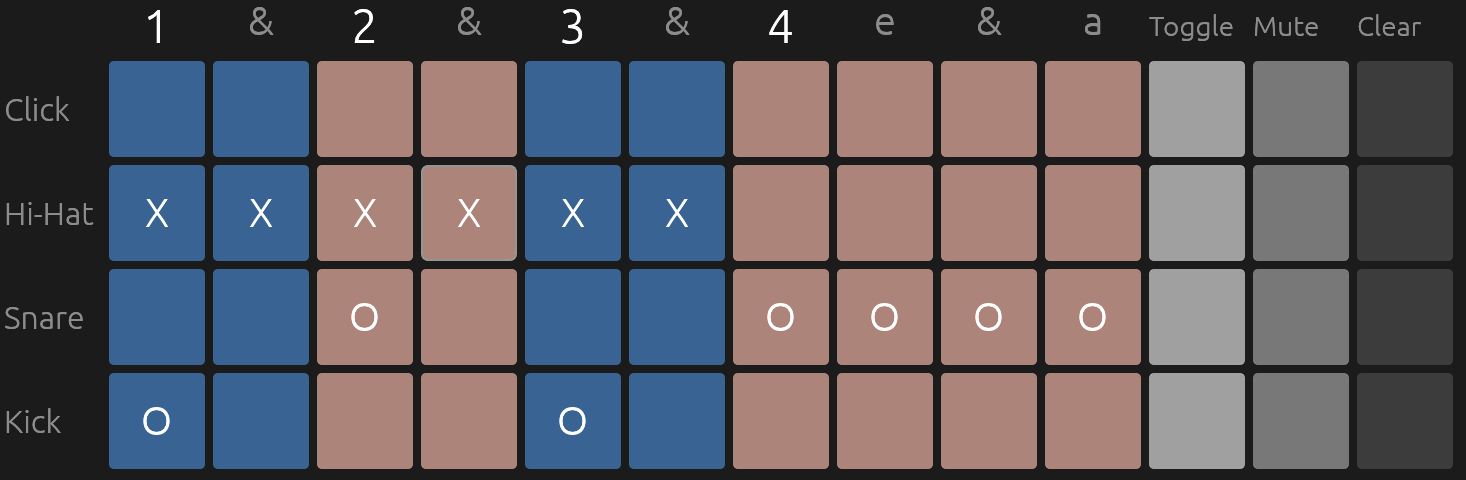
In my article about commercially available metronome apps featuring a gap click where the metronome silences itself for a configurable number of bars, I couldn’t find a single candidate that met all my requirements. So, I built my own. The original text of this post was created by my human intelligence in German. The translation was a collaboration between man and machine. The man was I and the machine was Google Translate. ...

The metronome is unexpectedly unpopular. At least with the rest of my family. I, on the other hand, like it. My old Yamaha electronic drum kit had a training function where the metronome would drop out for a set number of bars after playing for a set number of bars. It also featured a metronome where the click sound could be adjusted independently for different note values. My current electronic drum kit is probably too pro-level for that. An accent on the 1 is all it offers. Unfortunately, I’m no pro. So, I went looking for a replacement in the Google Play Store and spent a few euros testing out various apps. ...
Some time ago, I encountered my favorite drum groove during a lesson. In 50 Ways to Leave Your Lover, Steve Gadd plays the following unusual yet extremely fitting rhythm spanning two bars1. The original text of this post was created by my human intelligence in German. The translation was a collaboration between man and machine. The man was I and the machine was Google Translate. Bar 1 Count 1 e & a 2 e & a 3 e & a 4 e & a Hand L R L R L RRL R L Hi-Hat x x x Snare o o ooo o o Floor Tom o Bass Drum o o o Hi-Hat Foot x x Count 1 e & a 2 e & a 3 e & a 4 e & a Bar 2 ...

Since I live in a ground-floor apartment in a multi-unit building, I started out with a Yamaha DTX6K E-drum kit out of consideration for the neighbors living above me. Back then being completely clueless, I was told that the TCS silicone material used for the snare offered a realistic playing feel. After playing on the thing for about three years, I have to admit that it doesn’t actually feel that bad. However, it has too much rebound compared to an acoustic snare drum. I noticed this when I was able to play things on the DTX6 that simply didn’t work on the acoustic kit at my music school. So, after about three years, I set out in search of a more realistic playing feel without generating the volume of an acoustic kit. That was about nine months ago. Since I was prioritizing playing feel, I won’t say much about the kit sounds in this post. They were generally good enough for my untrained ears. I can say right up front, however, that I still prefer playing on an acoustic drum kit above all else. ...
The average drum student quickly encounters various patterns or figures, the so-called rudiments. Initially, there are single strokes played alternatingly with the left and right hand. Later, one encounters more complex rudiments, often derived from marching snare drumming, which are used on the drum kit, particularly in fills. The original text of this post was created by my human intelligence in German. The translation was a collaboration between man and machine. The man was I and the machine was Google Translate. ...
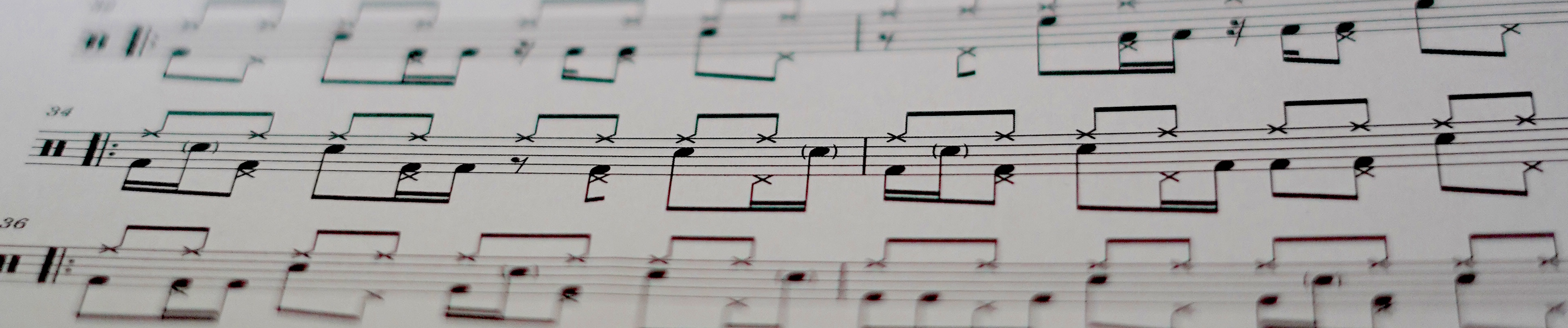
My latest hobby is playing the hi-hat with my foot on the offbeats, i.e., the & in 1 & 2 & 3 & 4 &. Due to limited independence of my limbs, I had to restrict myself to the following version*The ride cymbal can also be replaced by one or more toms.: The original text of this post was created by my human intelligence in German. The translation was a collaboration between man and machine. The man was I and the machine was Google Translate. ...
In this somewhat personal article, I describe my thoughts and experiences as someone who started playing drums at the age of 39 and otherwise has very little musical experience. The original text of this post was created by my human intelligence in German. The translation was a collaboration between man and machine. The man was me and the machine was Google Translate. What has happened so far Before his 7th birthday, I asked my then-noisy child if he would like to learn drums and would forgo other birthday presents in return. Surprisingly, the child was very happy to oblige. ...
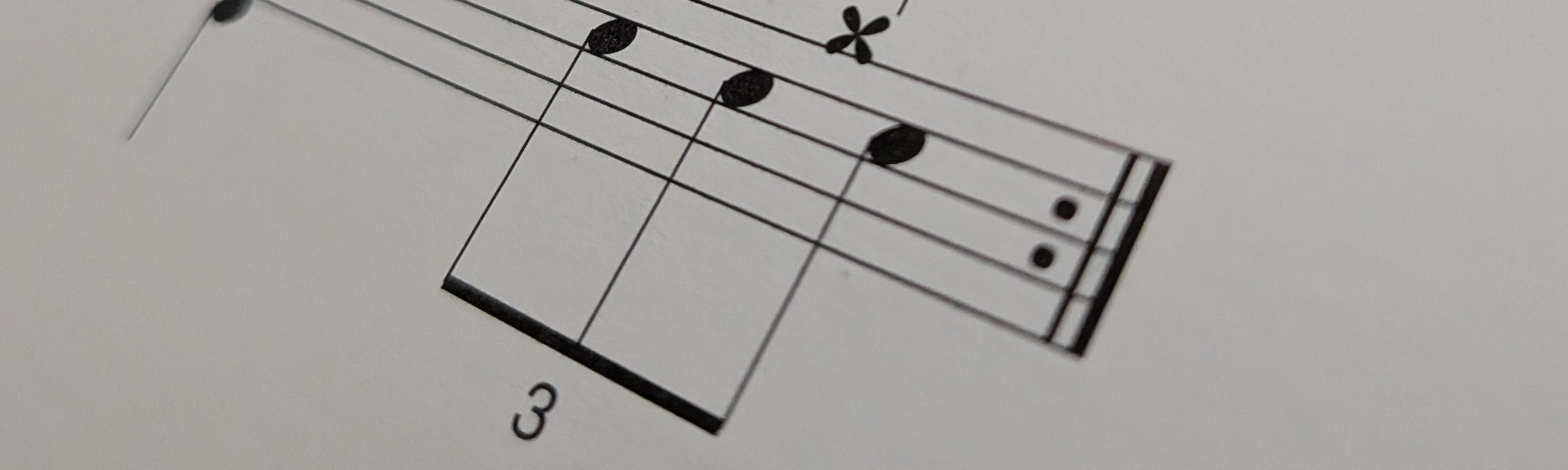
I’ve been playing drums for about three years. I recently came across the following simplest of all non-degenerated polyrhythms. The original text of this post was created by my human intelligence in German. The translation was a collaboration between man and machine. The man was I and the machine was Google Translate. The first three quarter notes follow a completely normal eighth-note rhythm. Then comes a kind of crazy triplet fill on the snare, while the hi-hat continues. I encountered this in Solo 17 from Tom Hapke’s book, 66 Drum Solos. When I saw it, I thought, “What the hell is that? How am I ever going to be able to play something so crazy?” That same day, I had my drum lesson. Desperately, I asked my teacher. He told me he would play it but with tom*not Hapke but the drum. This joke works better in German, because there both are capitalized. and snare instead of hi-hat and snare and I should just repeat by ear. It sounded something like this: ...
Monads, as they occur in functional programming, seem crazy and difficult to understand to me. Above all explanations and references to the mathematical subfield of category theory are confusing to me. In this post, I’m trying to explain a concept that I haven’t penetrated very deeply myself, in an introductory, application-oriented and superficial way, so that you can become the head nerd at the next party of imperative nerds. This is a translation of the original German article in a collaboration between man and machine. ...
After a period of deprivation and frugality, Luise has entered a phase of greater financial freedom. All her funds are in an ETF portfolio that averages a 7% return in the long term. Unfortunately, the 7% return is not constant and fluctuates significantly. Luise plans to withdraw a certain amount every month, either through dividends or by selling shares. Before I continue with a financial-themed story, I want to clarify that I’m not a financial expert. I’m just an individual who is interested in personal retirement planning and other financial topics, accumulating some solid half-knowledge along the way, and occasionally relying on my more or less sound common sense. From time to time I create or extend a calculator. ...